
Organic Media/Getty Images
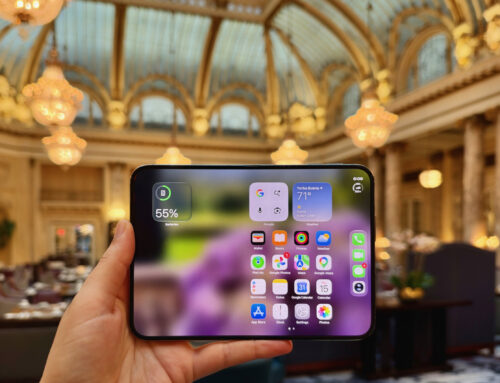
Depending on the iPhone model you currently use, you may see up to two lock icons on the screen at the same time. Both may be visible on the Lock Screen, but only one may be visible on the Home Screen. But even the lock icon that stays visible while the phone is in use may only be seen when you invoke the Control Center. The Control Center itself may have a lock icon that matches the one that remains visible.
Longtime iPhone users are probably well aware of the meaning of the two lock icons, but things may be confusing for new iPhone users or less tech-savvy users. The two icons both indicate that a specific function is locked. The simple lock icon that appears on the screen briefly tells the user that the iPhone is locked and needs to be unlocked to be used. The lock inside a circle that sits next to the battery icon tells you that screen orientation is locked regardless of whether you hold the handset in Portrait or Landscape mode.
These indicators are important visual cues that can offer immediate information to the user, without having to inspect any settings. For example, seeing a simple lock icon in the middle of the status bar, under the Face ID notch, or inside the Dynamic Island is a visual indication that the handset is locked, and therefore safe, as your information is encrypted.
As for the lock icon inside a circle, it tells you that the screen orientation is locked so you don’t have to worry about the iPhone screen changing orientation accidentally while you scroll social media in bed. The icon also reminds you that you need to disable the lock to watch videos in landscape mode.
How to manage the Portrait Orientation Lock
Thaspol Sangsee/Shutterstock
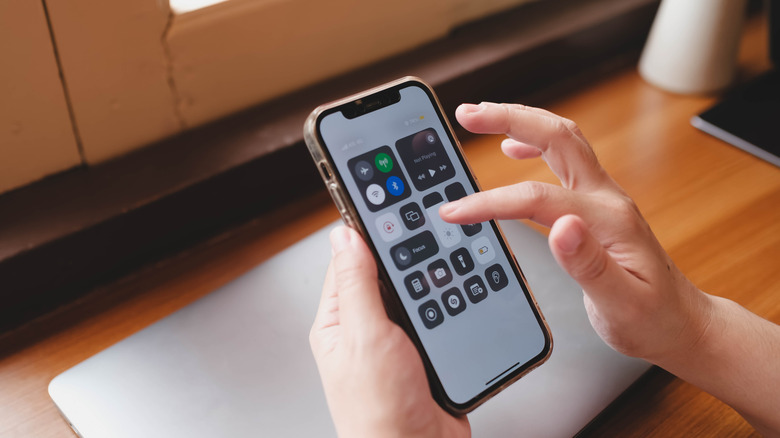
If you own an iPhone with a Home button, which also has a display with large top and bottom bezels, the Portrait Orientation Lock will always be visible next to the battery icon. The icon shows a lock inside a circular arrow. In other words, the lock tells you that the screen will not rotate when the handset rotates in your hand. If you own an iPhone with a notch (iPhone X to iPhone 14, iPhone 16e, and iPhone 17e) or an iPhone with a Dynamic Island cutout (iPhone 14 Pro to iPhone 17 series), the status bar doesn’t have enough space to display the icon showing the lock inside a circular arrow. However, that icon becomes visible next to the battery icon as soon as you open the Control Center on these models, by swiping down from the top-right corner of the screen.
To turn Portrait Orientation Lock on and off, you’ll have to look for the Portrait Orientation Lock toggle in Control Center, which shows a larger version of the lock icon. When the Portrait Orientation Lock is enabled, that icon is red. Tap it to disable it, and the lock will disappear from the status bar, while a button animation in Control Center will remove the red highlight. Text will also appear at the top of Control Center to inform you that you’ve toggled the setting on or off.
There’s also a way to automate the process. For example, you can create an iPhone shortcut to disable Portrait Orientation Lock automatically every time you open a specific app. This can be useful for watching videos on YouTube and Netflix. You can also set a shortcut to enable Portrait Orientation Lock when you close these video apps.
Why the other lock icon is important
Thaspol Sangsee/Shutterstock
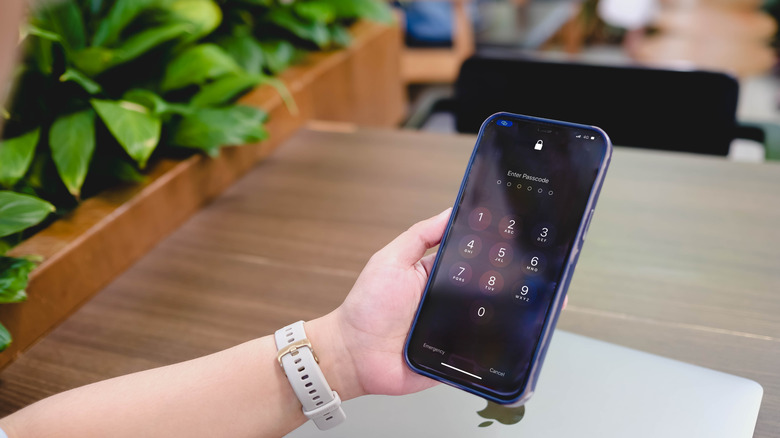
The plain lock icon that you might see on the display or in the status bar is even more important than the Portrait Orientation Lock indicator because it tells you that your handset is secure. The plain lock symbol appears in the middle of the status bar on iPhones with Home buttons. It shows under the notch on iPhone models that have the iPhone X-style cutout at the top, and it appears inside the Dynamic Island on all iPhones that have a pill-shaped cutout at the top. Unlike the Portrait Orientation Lock, which is visible next to the battery icon, the lock icon on the Lock Screen disappears when you unlock the handset, with an animation playing as the phone unlocks. The lock icon may remain visible in the Dynamic Island on iPhones that support Always-On Display.
The lock tells you, and anyone using your phone, that the device is protected by a passcode or PIN and Touch ID or Face ID. iPhones with Home buttons have fingerprint sensors in that button, and they support Touch ID unlock. All-screen iPhones with cutouts at the top have 3D face recognition (Face ID) unlock. You’ll want to set a passcode and enable Touch ID or Face ID on your device to ensure the device is encrypted when not in use, and that your data stays safe.
If lost or stolen, a locked iPhone will help protect your data, and it may even let you erase the data remotely. A locked handset also makes it much harder for thieves to reuse the device, especially if Find My iPhone is enabled, as this setting also turns on the Activation Lock feature. With that in mind, it’s not advisable to use your iPhone without a passcode.